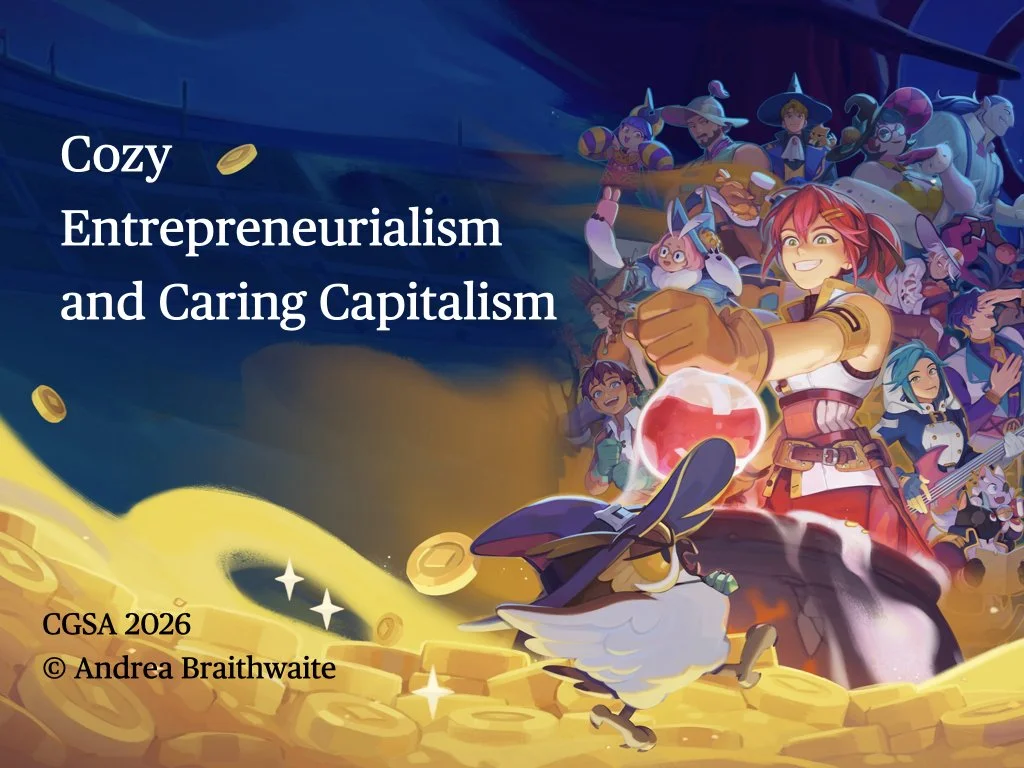
In the game Tiny Bookshop, you move to a small town and set up a tiny bookshop, slowly building connections with the townsfolk and becoming a part of the community – maybe even finding love. In the game Potionomics, you move to a small town and set up a tiny potion store, slowly building connections with the townsfolk and becoming a part of the community – maybe even finding love. In the game Discounty, you move to a small town and set up a tiny grocery store, slowly building connections with the townsfolk and becoming a part of the community – maybe even finding love.
Entrepreneurialism is a common component of many games labelled as “cozy.” Games like Tiny Bookshop, Potionomics, and Discounty, among many, many others, help popularize and codify the small-town business owner as a key trope in cozy media. The cozy genre also often imagines the small town as a space of emotional or caring capitalism. Today I’d like to peer inside a few examples of this coziness to investigate how labour and retail environments are represented as sites of positive emotional experiences under and because of capitalism.
To more fully explore what we can think of, following Charles Taylor, as a social imaginary of coziness, I want to put these sorts of games in dialogue with another significant site of such cozy capitalism: the Hallmark made-for-TV movie. For example, in Pumpkin Pie Wars, the heroine runs a bakery, is a central part of her community, and ends up finding love. In Season for Love, the heroine runs a bistro, is a central part of her community, and ends up finding love. In Sweeter Than Chocolate, the heroine runs a chocolate shop, is a central part of her community, and ends up finding love. You get the idea.
Film and media scholar Kit Hughes describes Hallmark’s investment in entrepreneurialism as a “mainstream, positively-valenced representation of the SBO [small business owner] embedded in American cultural ritual” (63). By expanding across media sites Hughes’ investigation of “popular narratives that promote brutal economic relations” (Hughes 63), I connect the representational strategies found in many cozy games to the ones found in Hallmark’s cozy romance movies. Two spaces are particularly salient: the small town, and the small business. Like Hallmark movies, Tiny Bookshop,Potionomics, and Discounty rely on these spaces to construct a discourse of an “emotional” or “caring” capitalism that is key to making entrepreneurialism cozy.
Cozy games are often unproblematically embraced as the counter-hegemonic, subversive darlings of contemporary game production, with only a few folks raising questions about how they “also enable[] this troubling status quo in ways that cannot be ignored” (Scully-Blaker 131). By situating cozy entrepreneur games as part of a broader social imaginary, we can more clearly see the ways in which the games largely uncritically reproduce an understanding of neoliberalism and late capitalism as essential to collective happiness and community stability, rather than the central driver of their undoing.
In this way, cozy media that is organized around the reified figure of the entrepreneur helps circulate what Eva Illouz calls “caring capitalism” and Wanda Vrasti terms “emotional capitalism” – a discourse in which capitalism affectively enhances individual and communal well-being Small towns are central to this, and in cozy media they function as what Stephen Rowley, in his work Movie Towns and Sitcom Suburbs describes as notional places: “more generalized imaginary places—representations that we use to mentally describe and visualize a category of place” (7). In cozy media, the notional small town is the solution to, and not a site of, social problems. The small town atmosphere helps generate an affective consensus about how capitalism can create the “right” kind of happiness.
This happens in part through a few recurring representational strategies. One is the use of exterior long shots that capture the small town in all its pastoral glory. In Tiny Bookshop, for instance, you set up your portable store at heavily-trafficked locations like the fish market, the beach, and the lighthouse, amidst rolling hills and ocean views. Even the game’s menu screen situates your store in relation to the town’s rurality. These carefully programmed vistas construct Tiny Bookshop’s small town as an idyll in which “market-based cultural repertoires shape and inform interpersonal and emotional relationships, while interpersonal relationships are at the epicenter of economic relationships” (Ilouz 5).
The cozy emphasis on the small town Main Street, which Rowley notes is an “icon closely equivalent to small towns themselves,” (23) draws our attention to small-town economies and the role we the game’s entrepreneur play in maintaining them – and, by extension, the small town itself. Our store-management perspective in Potionomics, for example, frames our shop in relation to the town’s Main Street and the other small businesses on it; NPCs wander by to create an impression of this as an active, lived-in capitalist strip. In Discounty, we can do the wandering up and down Main Street, and can see the hustle and bustle of the vibrant small-town shopping district firsthand.
Such visual reinforcement of our store’s placement in the heart of its community finds its analogue in how Hallmark movies’ repetitive cinematography shapes our connection to the spaces in which emotional and economic triumphs take place. An early sequence from Where Your Heart Belongs is typical: the long shot of the small town cuts to a close-up of the town’s sign before the camera pulls back so we can watch heroine Mackenzie and her best friend Olivia hop out of their car and start walking through the town. Chatting about her upcoming wedding, bride-to-be Olivia connects the desirability of small-town life to an aesthetic capitalist experience when she gushes: “You have to admit Sweet Grove is cute. Small enough that the ma-and-pa stores are still in business, but big enough that it still has all the amenities we need to plan the wedding.”
These representational conventions establish the cozy’s small towns as feel-good spaces exempt from the significant socioeconomic challenges actual small towns currently face – what sociologists Thomas Halper and Douglas Muzzio call “a case of the dwindles” (19). Thanks instead to a caring capitalism that “realign[s] entrepreneurial conduct with a romantic vision of social order, intimacy, and autonomy,” cozy small towns are fantastical places capable of thriving (Vrasti n.p.).
The affective resonance of this imagery carries over to the interiors of these businesses, attesting that even on the inside, cozy small towns are especially nice. A close look at how characters and things are organized in interior scenes provides what film scholar Jiaying Sim describes as “ways of understanding everyday objects as productive assemblages of affective interactions and relationalities with other bodies within material culture” (30).
This drives the interior play of many cozy entrepreneur games. In Tiny Bookshop, for example, purchasing décor – and especially festive seasonal décor – is one of the very few uses of your profit (your other options are more inventory, and then subsidizing community projects like the amateur theatre). Such “emotionalization of economic conduct” is central to small-town sociability in these sorts of games (Illouz 5); in Potionomics, the same top-down view that locates the shop along the iconographic Main Street also lets us see the store’s interior, which we can then adjust to create a more aesthetic small business experience. Discounty similarly includes customizations that are – like these other two – of a particular, if pixelated, boho farmhouse aesthetic, reinforcing particular kinds of shopping spaces as authentically cozy, “small towny.”
This affective atmosphere of emotional or caring capitalism also characterizes the Hallmark small town. Consider, for instance, the mise-en-scène of Love at Daisy Hills in which the future of Daisy Hills General Store is in jeopardy as more customers turn to online shopping for their needs. The store’s welcoming, rustic vibe comes from its open floor plan, shiplap ceiling and weathered wooden floors, vintage containers and till, and burlap sacks full of nuts and spices. Part of the “built and affective infrastructure of the ordinary,” (Berlant 49) interior spaces crammed with consumable iconography thus work much like Main Street, perpetuating an atmosphere of sociability and niceness that anchors the narratives’ central tensions around saving local businesses and townsfolk from ruin both financial and emotional.
Capitalism is regularly a source of positive feelings and personal solutions in cozy media’s small town spaces, dramatizing how “capitalism has an affective dimension that finds expression through the terms of interpersonal sociability” (Bramen 332). Approaching these narratives as examples of caring capitalism highlights how “emotional life becomes integral to economic rationality, where intimate relations are the foundation and prototype for monetary transactions” (Vrasti, n.p.). By suturing caring capitalism into forms of interpersonal and community closeness, and imagining particular consumer spaces as especially nice, the entrepreneurialism we find in cozy games demonstrates how capitalism has become an integral part of the social imaginary of coziness.
References
Berlant, Lauren. 2008 The Female Complaint: The Unfinished Business of Sentimentality in American Culture. Durham: Duke University Press.
Bramen, Carrie Tirado. 2018. “Niceness in a Neoliberal Age.” Public Culture 30, no. 2: 329-50. https://doi.org/10.1215/08992363-4310954
Discounty. Crinkle Cut Games, 2025.
Halper, Thomas and Douglas Muzzio. 2011. “It’s a Wonderful Life: Representations of the Small Town in American Movies.” European Journal of American Studies 6, no. 1. https://doi.org/10.4000/ejas.9398
Hughes, Kit. 2026. “The True Meaning of Christmas (at Hallmark): The Miracle of the Small Business Owner.” Television & New Media 27, no. 1: 62-82. https://doi.org/10.1177/15274764251360946
Illouz, Eva. Cold Intimacies: The Making of Emotional Capitalism. Polity, 2007.
Love at Daisy Hills. Dir. Séan Geraughty. Hallmark Media, 2020.
Potionomics. Voracious Games, 2022.
Pumpkin Pie Wars. Dir. Steven R. Monroe. Hallmark Media, 2016.
Rowley, Stephen. Movie Towns and Sitcom Suburbs: Building Hollywood’s Ideal Communities. New York: Palgrave Macmillan, 2015.
Scully-Blaker, Rainforest. 2024. “The Politics of Wholesome Games: Conservative Comforts and Radical Softness.” Configurations 32: 129-43.
Season for Love. Dir. Jill Carter. Hallmark Media, 2018.
Sim, Jiaying. “Affective Assemblages of Material Culture: Qi Pao, Mahjong and Performance in Ang Lee’s Lust, Caution.” Film-Philosophy 27, no. 1 (2023): 29–49. https://doi.org/10.3366/film.2023.0215.
Sweeter Than Chocolate. Dir. David Weaver. Hallmark Media, 2023.
Taylor, Charles. Modern Social Imaginaries. Duke UP, 2004.
Tiny Bookshop. neoludic games, 2025. Vrasti, Wanda. “‘Caring’ Capitalism and the Duplicity of Critique.” Theory & Event 14, no. 4 (2011). https://doi.org/10.1353/tae.2011.0041.
Where Your Heart Belongs. Dir. Christie Will. Hallmark Media, 2022.